
A tankless water heater works by heating cold water instantly on demand using a high-powered gas burner or electric heating elements, completely bypassing the need for a storage tank. When you turn on a hot water tap anywhere in your home, a flow sensor detects the movement of water, igniting the heat source to warm the water as it travels through a compact heat exchanger. If you have a large household with high hot water demands and active gas lines, choose a gas tankless water heater for its superior flow rate. If you live in a smaller home with moderate needs or lack a gas line, choose an electric tankless water heater for a lower upfront cost and simpler installation. Ultimately, this on-demand process prevents standby energy loss, ensuring you never run out of hot water while lowering your monthly utility bills. Let us take a closer look at the mechanics, costs, and lifespan of these modern systems so you can make the right choice for your Middle Tennessee home.
Key Takeaways
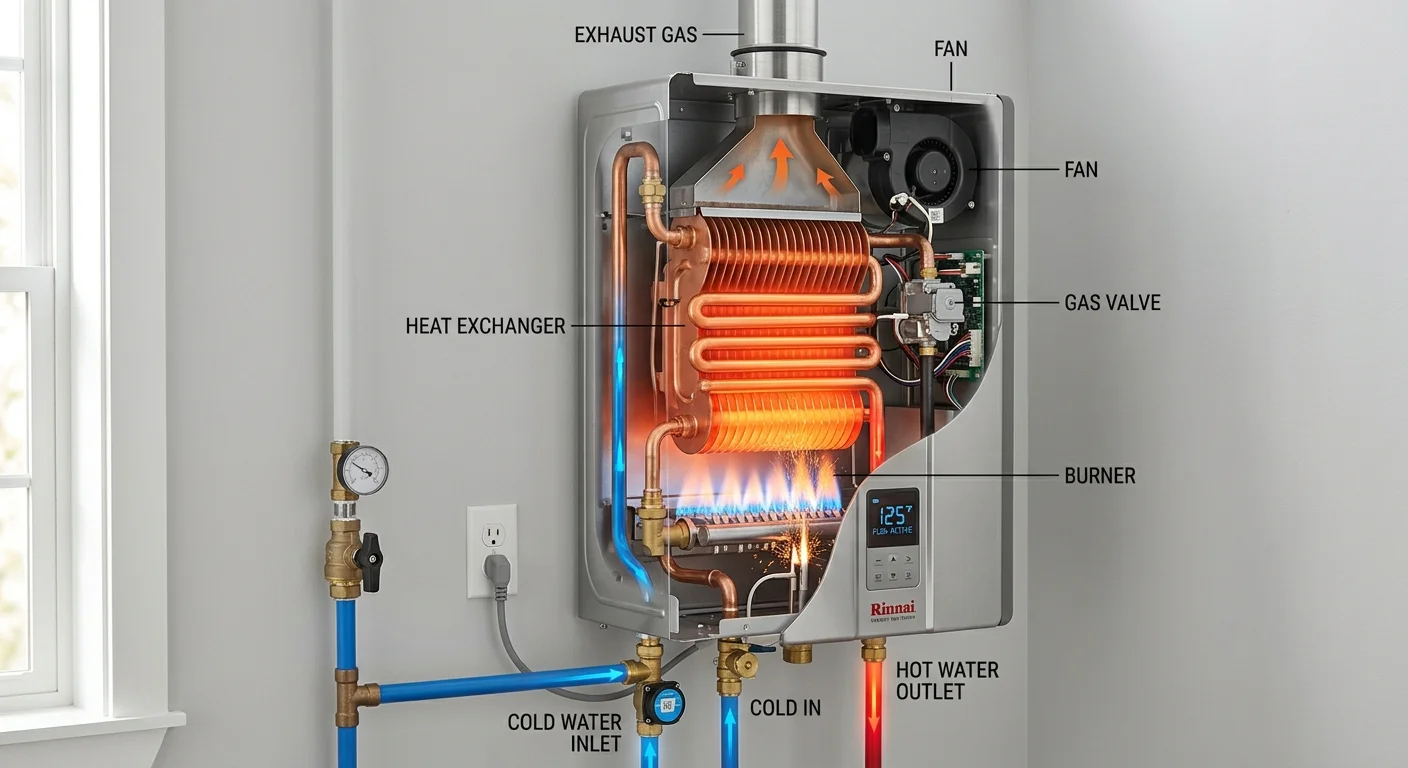
- On-Demand Heating: Tankless water heaters activate only when a hot water faucet opens, heating water instantly through a highly efficient heat exchanger.
- Energy Efficiency: By eliminating standby heat loss from a storage tank, tankless systems can reduce energy use significantly compared to traditional tanks.
- Extended Lifespan: A professionally maintained tankless water heater can last up to 20 years or more, which is nearly double the lifespan of a standard tank model.
- Space-Saving Design: These compact, wall-mounted units free up valuable floor space in utility closets, garages, or basements.
- Professional Installation Required: Complex gas venting, gas line sizing, and electrical load requirements mean these systems must always be installed by certified professionals.
What is a Tankless Water Heater?
To understand how these systems operate, we must first answer the fundamental question: what is a tankless water heater? Often called an on-demand or instantaneous water heater, this compact unit provides hot water only as it is needed, without relying on a large, pre-heated storage reservoir. Traditional water heaters continuously heat and reheat 40 to 80 gallons of water all day and night. This constant cycling wastes energy when nobody is home, which leads to higher energy consumption and increased monthly bills.
A tankless unit eliminates this waste by remaining in standby mode until you turn on a shower, washing machine, or sink. It is typically a small, rectangular metal box mounted to a wall, taking up a fraction of the physical space required by a bulky tank. Inside this compact cabinet lies a sophisticated array of sensors, control boards, and heating elements engineered to instantly raise incoming groundwater temperatures to your desired setting. By heating water dynamically, these units provide a continuous supply of hot water that theoretically never runs out, making them highly attractive to growing families.
How Does a Tankless Hot Water Heater Work Step-by-Step?
An internal flow sensor, a computerized control board, and a high-efficiency heat exchanger work together in a precise sequence to heat water instantly. The moment you twist a hot water handle in your bathroom or kitchen, a highly coordinated mechanical sequence begins inside the unit. Here is the step-by-step process of how a tankless hot water heater work cycle functions:
- The Flow Sensor Activates: When a hot water tap opens, cold water begins rushing into the bottom inlet pipe of the tankless unit. An internal flow sensor detects this movement and immediately alerts the computerized control board.
- The Control Board Calculates Heat Demand: The electronic control board measures the incoming water temperature and compares it to the target temperature set on your thermostat. It instantly calculates the exact thermal energy required to bridge that temperature gap.
- The Burner or Heating Element Ignites: For a gas unit, the control board opens the gas valve and ignites the burner. For an electric unit, the control board sends high-voltage electrical current to activate heavy-duty copper or stainless steel heating elements.
- Heat Exchange Occurs: Cold water winds through a tightly coiled copper or stainless steel pipe called the heat exchanger. The burning gas or intense electric elements heat the outside of these pipes, transferring thermal energy directly to the water flowing inside.
- Water Temperature is Regulated: Outflow sensors continuously monitor the exiting water temperature. The control board modulates the burner flame or electric voltage up or down in real-time to ensure a steady, safe temperature.
- Venting and Exhaust: In gas models, combustion byproducts are safely pushed outdoors through a dedicated PVC or stainless steel vent pipe, while the hot water flows directly to your open tap.
Once you turn off the faucet, the water flow stops completely. The flow sensor detects this change, signals the control board, and the burners or heating elements shut down instantly, returning the unit to an idle state.
Differences in Gas and Electric Tankless Water Heater Work Cycles
While both types of systems deliver hot water on demand, their heating mechanisms and installation requirements are completely different. Gas tankless units use a natural gas or liquid propane burner to produce a high-intensity flame. This flame heats a primary (and sometimes secondary) heat exchanger to warm the water. Gas systems have a much higher heating capacity, meaning they can heat more gallons of water per minute (GPM) than electric models. This makes them the ideal choice for larger homes in Brentwood or Nashville where multiple showers might run simultaneously.
Electric tankless units, on the other hand, rely on heavy-duty electric resistance coils. As water passes over these coils, the electrical resistance generates the heat needed to warm the water. While electric units are highly efficient and require no ventilation pipes, they draw a massive amount of electrical current. Installing a whole-home electric tankless water heater often requires an electrical panel upgrade to 200 or 300 amps, along with multiple dedicated double-pole circuit breakers.
Let us compare the core characteristics of these two technologies to see how they stack up in real-world scenarios:
| Feature | Gas Tankless Water Heaters | Electric Tankless Water Heaters |
|---|---|---|
| Heating Speed & Capacity | High (4.5 to 9.0+ GPM), ideal for multi-bath homes | Moderate (2.0 to 5.0 GPM), better for smaller homes |
| Venting Requirements | Requires dedicated exhaust venting to the outdoors | No venting required, operates quietly indoors |
| Upfront Equipment Cost | Higher ($1,200 to $2,500 for the unit itself) | Lower ($500 to $1,200 for the unit itself) |
| Utility Infrastructure | Needs a properly sized gas line and gas meter | Requires massive electrical capacity (often 120-150 amps) |
Is a Tankless Water Heater Worth It for Middle Tennessee Homeowners?
Investing in a tankless water heater is highly worth it for homeowners who plan to stay in their homes long-term and want to lower their energy bills. The answer depends heavily on your household’s hot water usage patterns, local utility rates, and how long you plan to stay in your home. According to research published by the U.S. Department of Energy, homes that use 41 gallons or less of hot water daily can enjoy 24% to 34% greater energy efficiency with a tankless water heater compared to a conventional storage tank. For high-use households, the efficiency improvement is still a significant 8% to 14%.
From a financial standpoint, a tankless unit has a higher upfront cost than a standard tank. A traditional tank replacement might cost between $1,200 and $2,500. Conversely, a tankless water heater installation typically ranges from $3,000 to $6,500 depending on the retrofitting required for gas lines, venting, or electrical panels. However, the ENERGY STAR program estimates that the average family can save roughly $100 or more per year on gas bills with a certified tankless unit, allowing the system to pay for itself over its extended lifespan.
In Middle Tennessee, our local water quality is also a major factor to consider. Municipal and well water in Nashville, Franklin, and surrounding areas often contains high levels of dissolved calcium and magnesium. This hard water can lead to mineral scaling inside the narrow passages of a tankless heat exchanger. For detailed insights on how different brands handle local water chemistry, read our comprehensive guide on Navien vs Rinnai vs Rheem Tankless options in Nashville. Coupling your tankless system with a water softener is highly recommended to protect your investment from premature scale damage.
How Long Does a Tankless Water Heater Last Compared to Tanks?
A high-quality tankless water heater will last between 20 and 25 years when properly maintained by a professional. This is a dramatic improvement over standard tank-style water heaters, which generally have a lifespan of only 8 to 12 years before the tank corrodes and risks leaking. By choosing tankless, you are investing in a system that can reliably serve your home for more than two decades, saving you the hassle of frequent replacements.
According to product testing data from Consumer Reports, the absence of a large metal storage tank full of standing, corrosive water is the primary reason tankless units last so much longer. Traditional tanks suffer from constant thermal expansion and sediment settlement, which eventually eats through the protective glass lining and causes the steel tank to rust out. Tankless systems use modular, replaceable components like burners, sensors, and heat exchangers. If a single part fails, an experienced technician can easily replace it, whereas a leaking tank requires a complete system replacement.
However, reaching that 20-year milestone requires consistent professional care. Hard water minerals will bake onto the inside of the copper heat exchanger over time. This mineral barrier forces the burners to run hotter and longer to heat the water, leading to metal fatigue and eventual cracking. To avoid this, you should have a professional perform an annual flush of your system to descale the heat exchanger and clear out any sediment. Attempting to flush the unit yourself can damage the sensitive internal electronic components or void your manufacturer’s warranty.
Is Tankless Water Heater Better for Your Home’s Daily Routine?
A tankless water heater is better for your home if you want endless hot water and want to free up storage space. If you have a large family where the last person in the shower is always stuck with freezing cold water, a tankless system is a game-changer. Because it heats water dynamically as it flows, it offers an endless stream of hot water. You can run back-to-back showers, do loads of laundry, and run the dishwasher without ever running out of hot water.
However, it is vital to understand the difference between endless hot water and “instant” hot water. A tankless water heater does not deliver hot water to your faucet any faster than a tank system does. The hot water must still travel through the pipes from the heater to your faucet, which takes time. Additionally, tankless systems have a physical limit on how many gallons of hot water they can produce at one time. If you turn on three showers, a washing machine, and a dishwasher simultaneously, the unit may struggle to supply enough GPM to maintain high temperatures at every fixture.
To prevent this issue, a certified technician will carefully calculate your home’s total peak hot water demand. Common professional mistakes include installing an undersized unit to save money upfront, which leads to lukewarm water during peak usage hours. By choosing a unit with the correct GPM rating for our climate, you can enjoy all the benefits of unlimited hot water without any frustrating drops in temperature.
Why You Must Avoid DIY and Hire a Professional Water Heater Plumber
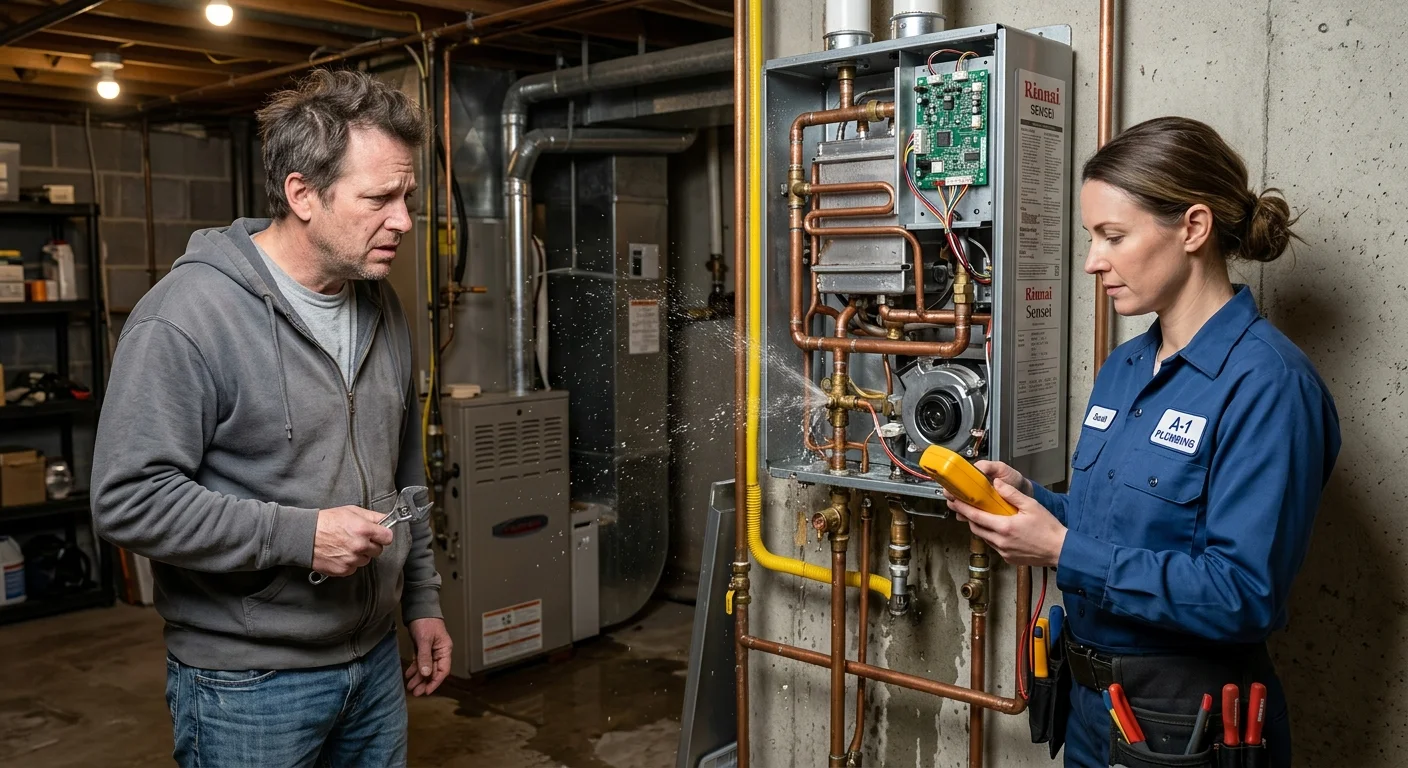
While there are many home improvement projects you can tackle yourself, installing or repairing a tankless water heater is definitely not one of them. These systems are highly complex, combining high-voltage electricity, high-pressure gas, precise water flow rates, and specialized venting requirements. A single mistake during installation or maintenance can lead to serious hazards, including carbon monoxide poisoning, gas leaks, electrical fires, or severe water damage to your home.
For example, a gas tankless unit requires a specific type of venting system, often using double-walled stainless steel or specialized PVC, to safely exhaust highly acidic combustion gases. Improper venting can vent dangerous carbon monoxide back into your living space. Furthermore, a gas tankless system can draw up to 200,000 BTUs of gas instantly. This requires a larger gas supply line than a standard tank, which only draws around 40,000 BTUs. Only an experienced water heater plumber has the training and specialized tools to size your lines correctly, safely connect the electrical controls, and ensure your system complies with all local Middle Tennessee building codes. Trusting an expert ensures your manufacturer’s warranty remains fully intact while keeping your family safe.
Get Expert Assistance from the Hot Water Heater Pros
If your old water heater is struggling, leaking, or driving up your energy bills, you do not have to handle it alone. At The Hot Water Heater Pros, we specialize exclusively in water heater systems, delivering fast, honest, and professional service across Franklin, Brentwood, Nashville, and the surrounding Middle Tennessee area. Our team of certified technicians can help you evaluate your household’s water usage, test your local water hardness, and recommend the perfect tankless or traditional water heater for your budget.
We pride ourselves on upfront pricing, clean professional installations, and a customer-first approach that ensures you get the exact hot water solution you need. Do not risk a cold shower or a costly DIY mistake. Contact us today to schedule your free consultation, and let our professional water heater service bring reliable, energy-efficient hot water back to your home.
